Ethiopia · Ethiopia & Eritrea
The Habesha
Wedding Tradition
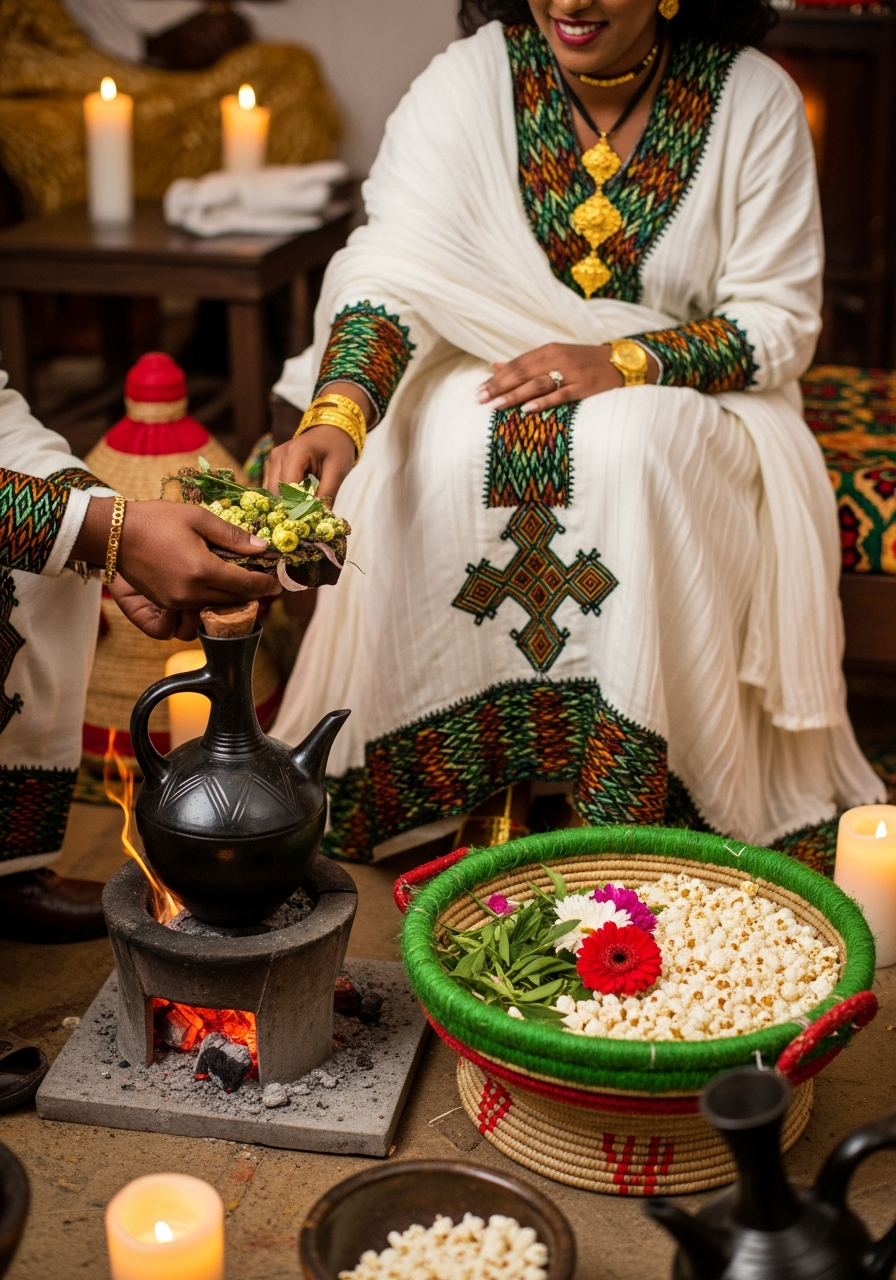
The Habesha people of Ethiopia and Eritrea have maintained one of the world's oldest and most coherent wedding cultures, one shaped by the Ethiopian Orthodox Church, pre-Christian Habesha customs, and the remarkable material culture of the Ethiopian Highlands. The Habesha kemis, a white dress with elaborately embroidered borders in silk thread, is among the most recognisable traditional garments in Africa.
The Coffee Ceremony (Buna) is the ritual heart of Habesha hospitality and celebration. At a Habesha wedding, the ceremony is performed three times, three rounds of progressively weaker coffee, each with its own name and spiritual significance. To share these three cups is to enter the deepest circle of Habesha welcome.
Quick Facts
The Wedding Structure
Key Ceremonies
Telosh
Engagement
The formal engagement ceremony where the groom's family visits the bride's home with honey wine (tej), bread, and cloth. Elders from both families negotiate the terms of the union in a highly formalised exchange. The engagement is often announced at the end of the Ethiopian Orthodox liturgical calendar's significant holidays.
Arras
Orthodox Church Blessing
The Ethiopian Orthodox church ceremony, the Arras, is the spiritual apex of the Habesha wedding. The priest blesses the couple, placing crowns on their heads and the rings on their fingers. The ceremony is conducted in Ge'ez, Ethiopia's ancient liturgical language.
Buna (Coffee Ceremony)
The Three Rounds
Green coffee beans are roasted over charcoal, ground by hand, and brewed three times, Abol (first, strongest), Tona (second), and Baraka (third, blessings). Each round is passed to every guest. To leave before the third cup is considered disrespectful; to stay through all three is to receive the full blessing.
What Makes This Tradition Unique
Sacred Elements
Habesha Kemis
The white cotton dress with silk embroidery (tilet) on the hem, collar, and sleeves is the national dress of Ethiopia and Eritrea. For a bride, the kemis is made from the finest white cotton and embroidered with patterns specific to her region. No other African bridal garment is as instantly recognisable.
Ethiopian Orthodox Crowns
At the Arras ceremony, gold crowns are placed on the couple's heads by the priest, a direct parallel to Byzantine imperial ceremony. The couple stands before the ark of the covenant's presence in the church. This is not a metaphor; in Ethiopian Orthodox theology, the tabot inside the church is the living presence of God.
Tej (Honey Wine)
Tej is Ethiopia's ancient honey wine, brewed in clay vessels and served in a distinctive flask-shaped bottle called a berele. At weddings, it is the drink of blessing and celebration. To offer tej to a guest is to say: you are in my inner circle.
Attire
The Habesha bride wears her kemis in the finest white cotton, with elaborate tilet embroidery in gold, red, and green (Ethiopia's national colours). A matching netela (shawl) is draped over the shoulders. Traditional gold jewellery and a head adornment complete the look.
The groom wears a matching white habesha outfit, pants, shirt, and shamma (white toga-style cloth) with embroidered borders that mirror the bride's kemis pattern. Matching outfits signal that the two families have agreed and the union is complete.
The Music
The kirar (five-stringed lyre) and masenqo (one-stringed fiddle) create the melodic foundation of Habesha celebration. Eskesta, the shoulder-roll dance unique to Habesha culture, is performed by everyone from children to grandparents at the reception. It is technically demanding; trying and failing charmingly is welcomed.
Practical Guide
For Guests Attending a Habesha Wedding
Stay for all three rounds of the coffee ceremony, leaving before the Baraka (third round) is considered rude.
When injera (the sourdough flatbread) is served, eat communally from the shared platter, it is a gesture of family and togetherness.
Eskesta (shoulder dance) will be encouraged from guests; attempting it with good humour earns great affection.
Dress modestly, the Ethiopian Orthodox context expects covered arms and shoulders in the church and during formal ceremonies.
Useful Phrases
Words for the Occasion
Universal Habesha greeting
Said to the couple
The deepest invitation in Habesha culture