Yɛkɔware Editorial
Published 7 March 2026 · 9 min read
Three rounds of coffee. Three hours. Often more than a hundred people. The Ethiopian and Eritrean coffee ceremony, called Jebena Buna in Amharic, is the most patient, most deliberate act of hospitality in the world. At a Habesha wedding, it is also a prayer, a communion, and a declaration of how seriously this community takes the joining of two people into a family.
The three rounds: Abol, Tona, Baraka
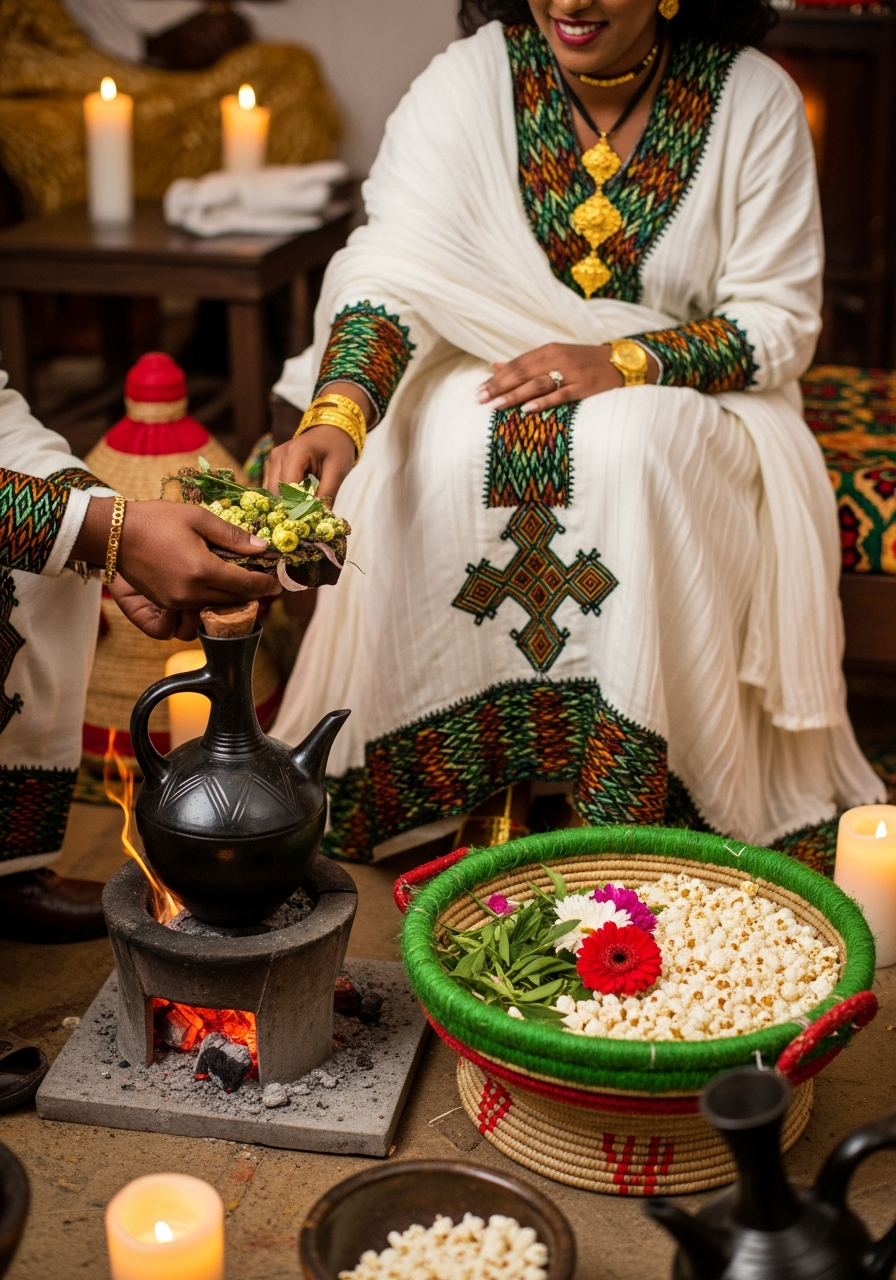
The ceremony proceeds in three rounds, each with a name and a distinct meaning. The first cup, Abol, is the strongest. Green coffee beans are roasted over charcoal in a pan called a maqacha, ground with a mortar and pestle, then brewed in the clay jebena pot. The first cup is served to the eldest members of the gathering, a gesture of respect. At a wedding, this round belongs to the two families' elders, a quiet moment before the day's louder celebrations.
The second cup, Tona, is slightly weaker. It is served more widely. The guests who were not elders are served now, the middle generations. Conversations open up. At a wedding, this is the round during which the families begin to mix, the groom's relatives finding their way to the bride's relatives, the initial formality softening.
The third cup, Baraka, means blessing. It is the lightest of the three, and it is served with the intention that the blessing of the ceremony travels home with each person who receives it. Children may be served the third round, often diluted further with milk. To be handed a cup of Baraka at a Habesha wedding is to be told that you are welcome in this family, that you carry their blessing.
Coffee was given to us by God. When we share it at a wedding, we are telling God: look, we are doing this right. We are asking for Your witness.
Who performs the ceremony
The coffee ceremony is performed by a young woman, traditionally unmarried, who has been trained in the ritual. She wears a white netela shawl and performs the entire ceremony from the roasting of the beans to the final pouring with focused, unhurried precision. Her role is not that of a servant; it is that of a ritual specialist. The ceremony cannot happen without her, and her performance is a contribution to the wedding as significant as any speech or drum ensemble.
The incense
Throughout the ceremony, frankincense and myrrh burn in a clay censer called a meketer. In Ethiopian Orthodox and Eritrean traditions, incense is a vehicle of prayer: the smoke carries intentions upward. The presence of incense transforms the coffee ceremony from a social ritual into a spiritual one. Guests who have attended many Habesha weddings say that the moment the incense begins to drift through the room is the moment they feel the ceremony is truly beginning.
For diaspora couples planning a Habesha ceremony outside East Africa, the coffee ceremony is often the element their non-Ethiopian guests find most transformative. It asks something of them that most social events do not: patience, presence, and the willingness to sit still for something unhurried. In a world that moves quickly, the Habesha coffee ceremony is a radical act of slowness; its power comes precisely from that.