Yɛkɔware Editorial
Published 12 February 2026 · 6 min read
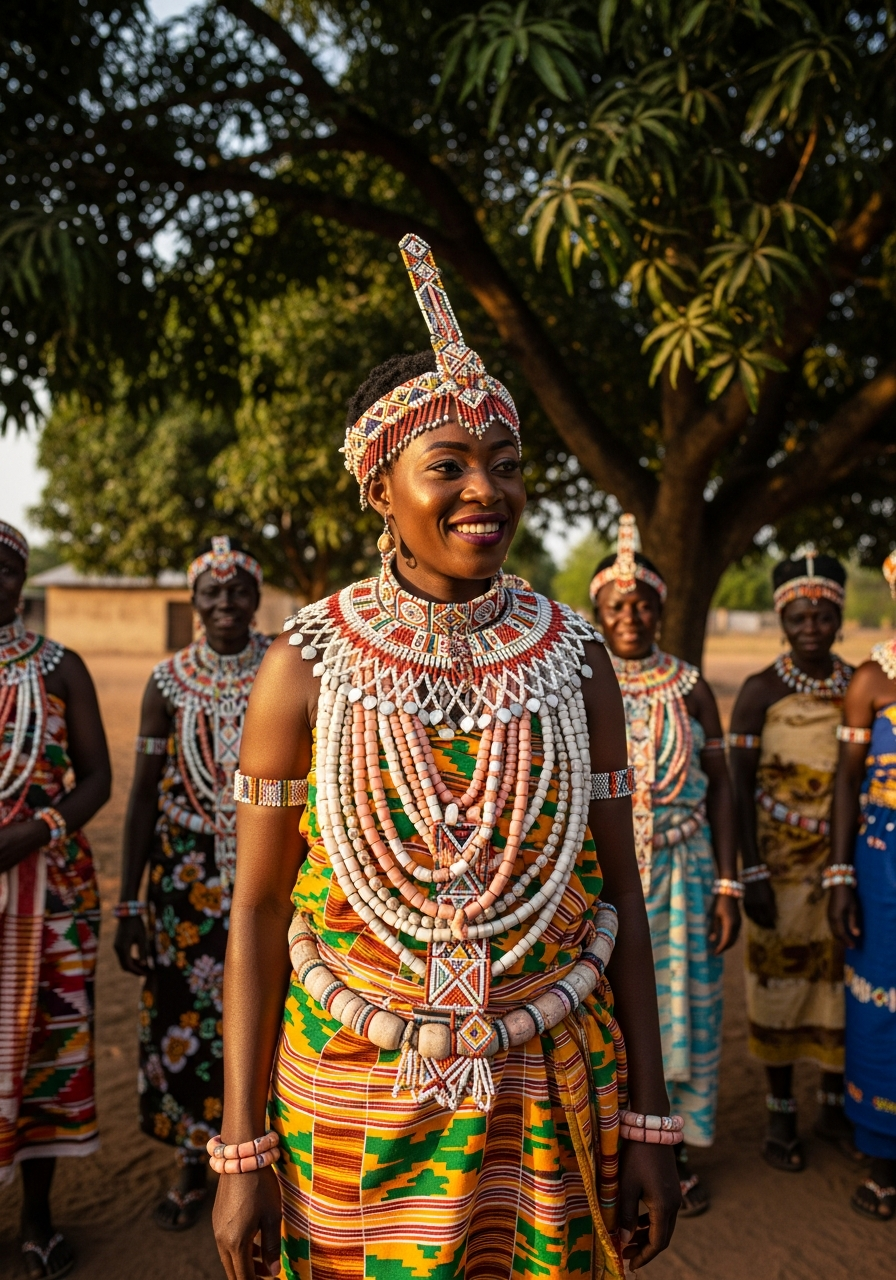
Among the Krobo people of Ghana's Eastern Region, beadwork is not jewellery. It is biography. Each bead placed on a Krobo woman's body at her Dipo initiation ceremony marks a chapter of her life. By the time she reaches her wedding, the strands of beads draped across her neck, chest, waist, and wrists represent an accumulation of family history, personal milestones, and the care and intention of every woman who gave her beads before her.
The Dipo initiation
The Dipo is the Krobo rite of passage for young women, marking the transition from girlhood to womanhood. Held annually in the months after harvest, it is a three-day ceremony of dance, song, instruction, and adornment. On the first day, initiates bathe and are dressed in white. On the second day, they receive instruction from elder women in the responsibilities of adult womanhood. On the third day, they emerge in full beadwork, presented to the community as women.
The beads given at Dipo are never discarded. They are accumulated, added to, inherited, and passed forward. A Krobo bride at her wedding may be wearing beads from her grandmother's Dipo, her mother's Dipo, and her own. The layers of history are literal: the older beads, softer in colour with age, rest against the brighter new strands. Each layer tells a generation.
The beads themselves
Krobo beads are glass trade beads, most of them made in the Krobo hills using a technique called powder-glass beadmaking. Recycled glass (bottles, windows, broken vessels) is ground into powder, placed in clay moulds, and fired in a kiln until it fuses. The resulting beads have a distinctive opacity and richness of colour that mass-produced beads cannot replicate. Each Krobo bead is unique: variations in temperature, the mixing of glass colours, the placement in the kiln all create beads that are individual in a way that no manufactured product is.
There is no bead in the world like a Krobo bead. You can feel the history in it. It is heavy in a way that matters.
At a Krobo wedding, the bride may wear the Powatɔ, a large ceremonial collar of graduated beads that rests from the neck to the chest. It can weigh several kilograms. The visual impact is extraordinary: when a Krobo bride enters her ceremony in full adornment, the room responds physically, a collective intake of breath at the weight and beauty of what she is carrying.
Krobo beadwork today
Krobo beads have become internationally recognised and collected, appearing in museums in London, New York, and Paris, and sought by collectors worldwide. This international attention has created both opportunities and pressures for Krobo bead-makers. The traditional powder-glass technique is being taught to new generations through workshops and apprenticeship programmes. Simultaneously, machine-made imitations have flooded global markets, making it harder to distinguish authentic Krobo beads from replicas.
For a Krobo bride planning her wedding adornment, the guidance of a knowledgeable elder woman remains irreplaceable. She will know which beads in the family collection are authentic, which strands carry particular significance, and how to assemble the complete look in the correct order. The Krobo bridal aesthetic is a living tradition: not a costume to be assembled from a catalogue, but a biography to be written collaboratively, across generations, one bead at a time.